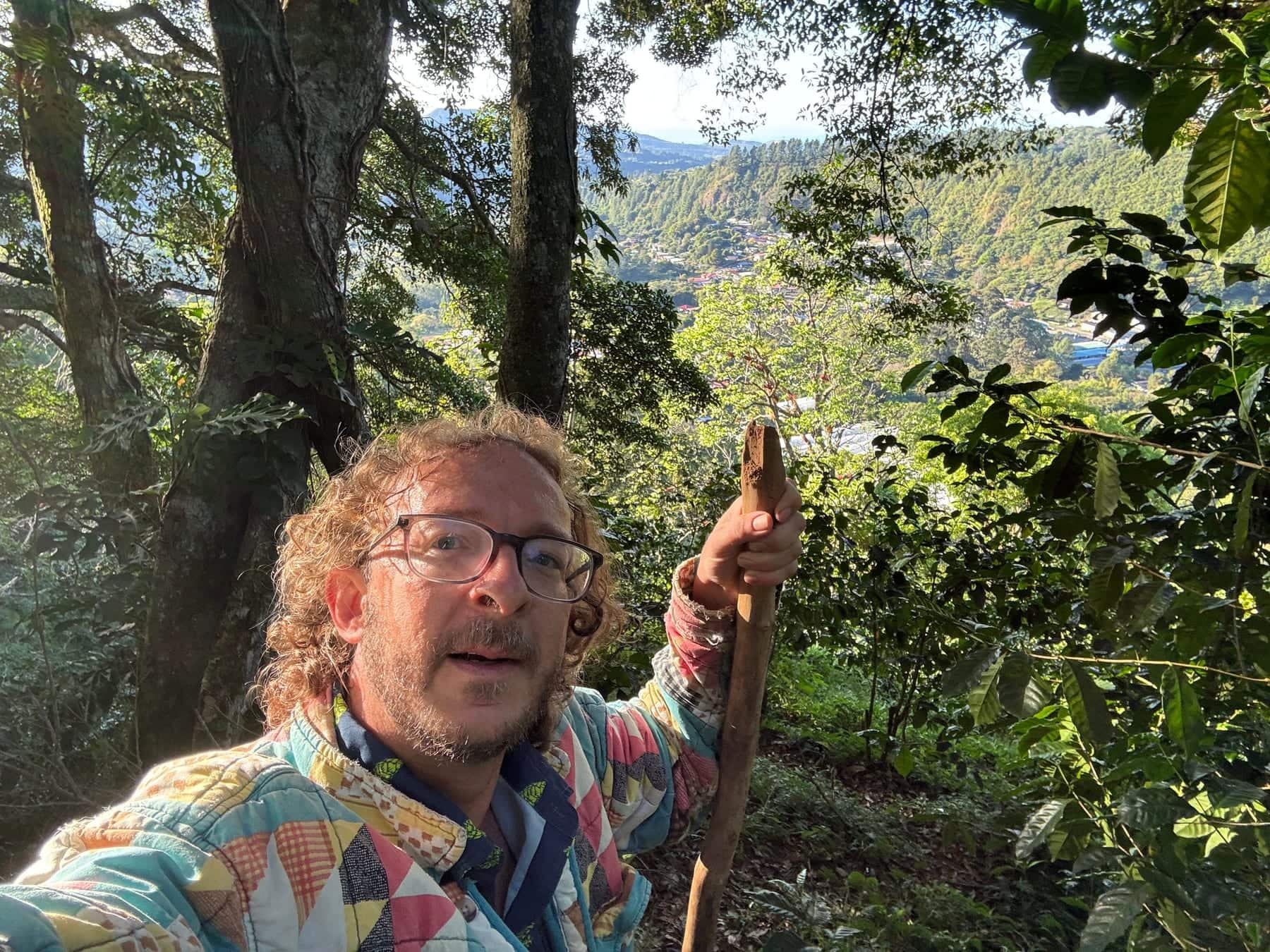
Daniel Giráldez
Fermenter and beekeeper
I keep four apiaries across different provinces, buy Geisha cherries in Boquete, and have been brewing professionally for twelve years. To me it is the same work: go to the place, understand what it produces, and transform it without inventing anything.
The first ferment I could not read
Before I devoted myself to drinks I studied psychology and spent a while making and selling handicrafts. On one of those trips around the country I met a Guna man who made chicha fuerte, a fermented drink that in his culture is prepared for special occasions and as a tonic.
I stayed several days watching him work. He dosed the alcohol of a maize fermentation with a precision I had no way of reading at the time: he knew when to stop, what to add, how the cacao and the ají chombo came in. Years later I understood what I had seen. It was fermentation control, done without instruments and with several generations of data behind it.
That is still my question: what is actually happening inside a ferment, and how it is explained.
Beer
I started brewing at home twenty-five years ago. I lived in San Diego during the craft beer boom and got to know producers who are now points of reference, such as Stone Brewing and AleSmith. What stayed with me was not only the taste for a beer with character. It was the communal part: working on something among several people and sharing it.
In 2014 I founded Cervecería Tres Gatos together with Roberto Coco de León and my brother José Giráldez. It is still going, with a taproom on Vía Argentina, and alongside it Craft Brewing Supply, the country's main distributor of brewing supplies, representing Weyermann, Fermentis, Yakima Chief Hops and FlavorActiv.
I trained in the Diplomado de Especialista en Cerveza at the University of Alicante (2018), I am a Certified Beer Server through the Cicerone programme, and I trained in sensory analysis with Bill Simpson of Cara Technology, in England. I have been a BJCP judge at Certified rank since 2018 and have taken part in more than thirty competitions in ten countries, among them the Copa Mediterránea, the Copa Quetzal, the Copa de Cervezas del Caribe, Cerveza México and the Best of Craft Beer Awards. I was selected as an international judge for the World Beer Cup 2027.
For a decade I also organised. I founded the Copa Puente del Mundo, Panama's first professional cup, which came to evaluate more than a hundred commercial beers, and I served on the board of the Asociación de Cerveceros Caseros de Panamá, the Copa Centroamericana and the Feria Cervecera Centroamericana. That structure no longer exists. What remained was a generation of trained brewers.
I have been teaching since 2015. Since 2020 I have taught at Beer School (Mexico), Costa Rica Beer School, CARAB and the Alicante programme, much of it online, for Spanish-speaking students in several countries.
Honey
Honey took me back to the countryside. I am a member and consultant of the Cooperativa de Apicultores de Panamá, and I keep four apiaries: Santa Fe de Veraguas, Los Asientos in Pedasí, Finca Rosina in Cerro Azul, and Penonomé. Some fifty hives in total, between the production of specialty honeys and pollination.
Four different places means four different bloom cycles, and that is exactly the part that interests me. I harvest and gather honeys from each one, and each arrives with its own information: the forest and the soil of that site, the season, and the hands of whoever works the land there. A honey from Pedasí does not resemble one from Cerro Azul, and that difference is not noise. It is the record of a place and of a particular year.
Out of that came apibotanical identification: follow the bloom, harvest according to the tree, and evaluate the honey with the same rigour as any other drink.
I have won mead awards in Mexico, Peru, Colombia and Central America, including Best Meadmaker at the Copa de los Muertos, in Mexico, and the award for best mead at the Copa Centroamericana in 2023 and 2024. It is the category I have competed in most, and that is no accident: in mead, honey stops being an ingredient and becomes the entire product. If the honey of a place and a season has something to say, that is where it is heard.
From that same logic came the Serie Madera y Miel, with Marcelino Guevara as collaborating beekeeper: apiary and field visits, and an apibotanical study to understand the bloom and the multifloral honey we harvest. That is where we saw the Cordia alliodora in flower — the tree they call laurel in those areas. We harvest honey during the bloom of Cordia alliodora and work wood from that same species: cured, dried, dehydrated, toasted in an oven or burned with a torch to build an aromatic profile. One tree, two raw materials, the same season.
In 2025 I gave the opening talk at Panama's national honey congress, within the framework of the competition. I am now designing sensory surveys to build a descriptive language of Panamanian honeys, which does not yet exist.
Coffee
I have been processing coffee for four years. I started with robusta in Penonomé, together with Rogusta Farms and Kiva Estate, and from there moved to arabica in the same area. My first project supporting special processes in Boquete was with Cafelino.
Afterwards I worked catuai, in Cerro Azul and in Boquete, and arabica in Cerro Azul.
2026 was my first harvest with Geisha. I buy cherries at Finca Las Nubes, Jaramillo Arriba, and at Finca Artillería, Alto Jaramillo, and process them under the CryoBloom protocol: a pre-fermentative cold hold, between 9 and 12 °C, on intact cherry and with Metschnikowia pulcherrima. Most of those lots came in above 90 CVA points.
Each region taught me something different. Lowland robusta and high-altitude Geisha are not processed the same way, and having worked both extremes is what lets me walk into a farm and see where the problem is.
That coffee I sell, I give sensory experiences with it, and I offer the methodology to farm and mill owners who want to apply it.
Chicha
And I came back to the beginning. I am looking for landrace maize, studying the microorganisms involved, and working the variants of chicha that exist in the country. I make them in the field and send them to competitions. Out of that same search came the wild yeast bioprospecting I did in Boquete's cloud forest. In Cusco I took part in an exchange comparing versions from Panama, Colombia and Ecuador with the Peruvian ones.
Out of that work came Chicha Power: chicha of new landrace maize, mixed and spontaneous fermentation, sixteen months in American oak barrel. Dry, with lively acidity and grain character.
Thirty years later I am still with the same drink. The difference is that now I know what I am looking at.
Néctar Nómada
Néctar Nómada is where all of this lives: the apiaries, the coffee, the ferments, the expeditions and the teaching. Go to the place, work with whoever produces, transform it with method, and tell exactly how it was done.
---