
The Yeast That Was Already Home
How a wild organism from a South American forest ended up defining German beer — and what that has to do with a Panama Geisha.
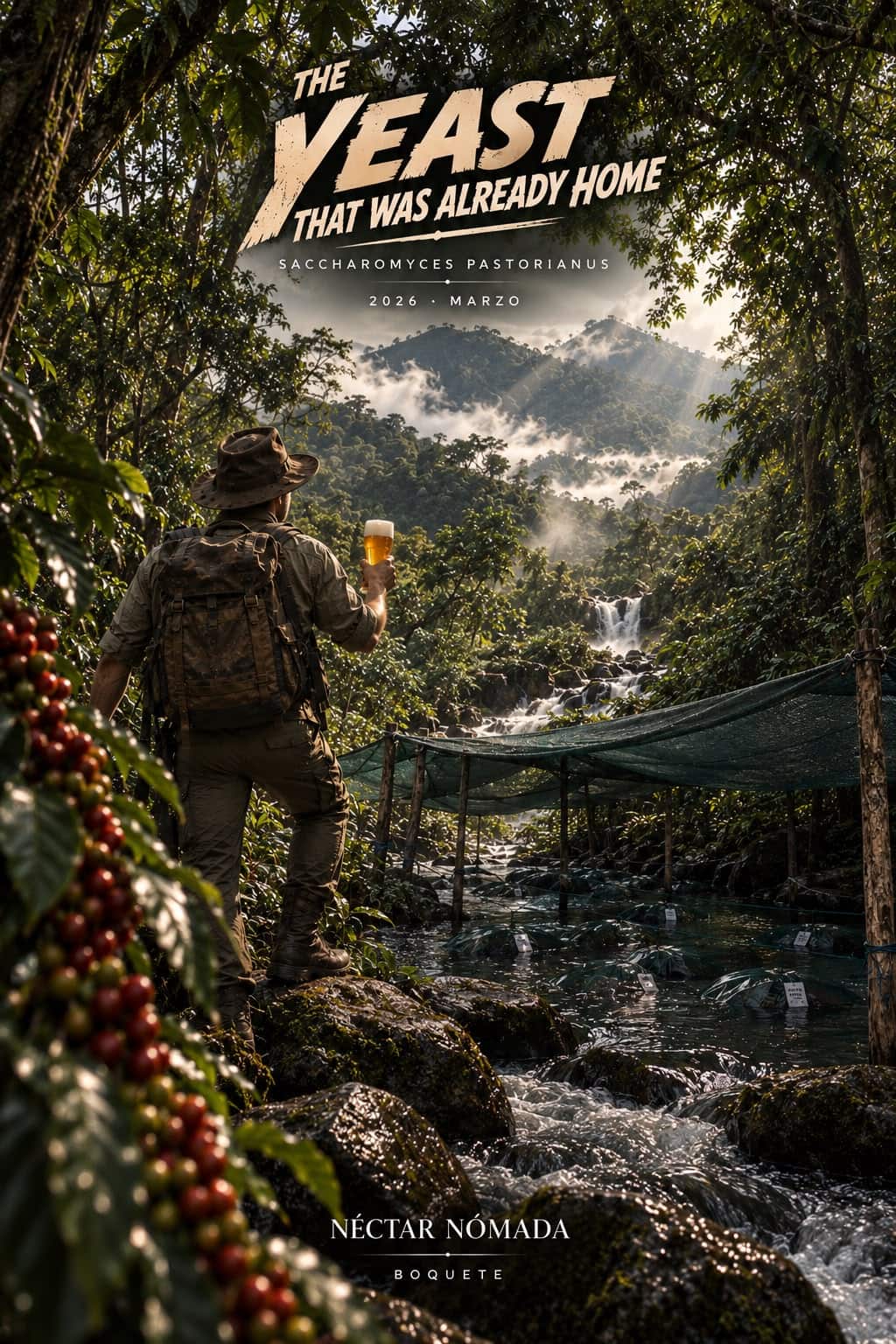
It's March, and I'm standing knee-deep in the Río Caldera, in the shade of the forest above Boquete, holding a GrainPro bag full of Geisha cherry that I've just carried down from Cafelino. The water is cold enough to ache. I push the bag under, weight it with a rock, and let the current settle around it. Five, six days like this. No starter culture from a sachet, no temperature-controlled tank — just cherry, river water, and whatever the mountain wants to do with it, except this time I'm the one deciding what goes in.
I've spent most of my working life moving between two rooms that don't usually talk to each other: a brewhouse and a cupping lab. One trained me to trust temperature control, sanitation, and a yeast strain chosen on purpose. The other tends to treat that same discipline with suspicion — as if choosing your fermentation deliberately were somehow less honest than leaving it to chance. Standing in that river, bag underwater, I wasn't thinking about the argument. I was just doing the work. The argument came later, at the cupping table.
There's a cup on the table now. Geisha, Lot 10, Cafelino — Alto Lino, Boquete, 1,300 to 1,500 meters up in the Chiriquí highlands. Fermented anaerobically in that same river water, cold, for five to six days. Jasmine on the nose. Red fruit, strawberry, a finish that turns bright and citric right at the end. Across repeated cupping sessions, it averages 92 on the CVA scale — ahead of the washed lot and the spontaneous natural from the same origin, same harvest.
The yeast that made it is a lager strain. Saccharomyces pastorianus — the organism behind Pilsner, behind Helles, behind five hundred years of Bavarian brewing tradition — fermenting a Panamanian coffee cherry in a Panamanian river.
That should sound like a contradiction. It isn't. The reason starts four thousand miles from that riverbank, in a forest most coffee people have never had reason to think about.
A law that never mentions the one thing that matters
In 1516, the Duke of Bavaria signed the Reinheitsgebot — the beer purity law. Water, barley, hops. Nothing else. It's one of the oldest food regulations still observed anywhere on earth, and it built the trust the world still extends to German beer: made honestly, made right.
Here's the detail that started changing how I thought about all of this: the law never mentions yeast. Not once. In 1516, nobody yet understood that fermentation was the work of a living organism — that discovery was still three centuries away. The law that defined purity for the world was written without any knowledge of the one ingredient that actually decides the outcome. I don't think that's a knock on the tradition. If anything, it's humbling. Bavarian brewing was built on patience and craft long before it had the science to explain itself.
What actually earns a lager its reputation isn't the three ingredients in that law — it's the method behind them. A cold, patient, bottom-fermenting yeast working slowly enough to leave almost nothing behind: none of the fruity esters or spice notes an ale yeast throws off, just malt and hops speaking clearly, without interference. Then weeks, sometimes months, of cold storage — lagern, literally "to store" — smoothing out anything rough before it ever reaches a glass. That precision is the real standard a great lager gets measured against.
And even inside that tradition, the styles we now treat as timeless were themselves deliberate adaptations. Pilsner was born in 1842 in Plzeň, Bohemia, brewed by a Bavarian brewer working with Bohemian malt and water. It spread fast enough to start eating into Bavaria's own market for its traditional dark beers. Munich's answer, in 1894, was Helles — the same clean, cold fermentation, reshaped around Bavaria's mineral-heavy water, built at Spaten specifically to compete. Even the beer most people now consider the gold standard of Bavarian tradition was, at the time, a deliberate response to outside pressure.
I think about that a lot as a coffee producer. We talk about "letting the coffee speak for itself" as though intervention and honesty were opposites. Five hundred years of Bavarian brewing says otherwise.
The mystery that took five hundred years to solve
Last September, I flew into Munich for drinktec, and after the trade show floor closed for the day, I made my way out to Weihenstephan — the oldest brewery on earth, and now also home to one of the world's most important yeast research collections. Dr. Juan Ignacio Eizaguirre, a friend and colleague, walked me through it — decades of collected strains, the quiet architecture of an institution still closing the gap that 1516 left open. We work commercially with strains that trace directly back to the lineage this whole story is about, so standing in that room felt less like a tour and more like meeting a relative.
The mystery those researchers eventually solved had sat unanswered for five hundred years: where did lager yeast actually come from? Lager is a hybrid — half Saccharomyces cerevisiae, the familiar ale-fermenting workhorse, and half something nobody could identify for centuries. In 2011, they found the missing half: Saccharomyces eubayanus, a wild yeast native to the beech forests of Patagonia, in South America. Not Bavaria. Not anywhere in Europe. Once hybridized, that single wild yeast now ferments more than ninety percent of all the beer made on this planet, according to Dr. Eizaguirre in a 2024 Braubeviale interview on the Weihenstephan Yeast Hunting project he works on.
It's worth being precise about how it got there, because it's tempting to romanticize this as some kind of natural crossing. It wasn't. A microorganism can't swim an ocean on its own. The leading theories point to human trade — barrels or ship timbers cut from South American wood, animals carried across as trade between the continents intensified in the 1500s. The exact route is still debated; some researchers think it arrived by way of Asia rather than a direct crossing. But nobody selected this yeast on purpose. It hitched a ride centuries before anyone knew it existed, and genome sequencing only found the trail in 2011 — a discovery that took nearly as long to surface as Pasteur's own proof, three centuries earlier, that fermentation was a living process at all. A good part of the scientific establishment of his day pushed back on that idea too; it sounded too simple, too alive, for something taken as seriously as beer or wine. Every generation, it seems, needs its own proof before it trusts what the science is already showing it. I don't think coffee is any different right now.
What "American" actually means here
There's a second thread worth pulling, and it needs to be stated carefully, because it's a real possibility rather than a settled fact.
Beyond Patagonia, the broader population of S. eubayanus has also been documented in parts of temperate North America, always associated with oak, or Quercus, forest — both American in origin. The montane cloud forest around Boquete and Volcán Barú is itself Quercus-dominated. No one has ever surveyed Panama's highland forest for wild cold-tolerant Saccharomyces populations. That's not evidence one exists there. It's evidence the right habitat does, and the question has simply never been asked.
Cold is the thread connecting both organisms in this story, and it's not a coincidence. S. eubayanus survives, and became lager's parent, because it tolerates cold. Geisha becomes what it becomes for almost the same reason — altitude, cool nights, the kind of stress that slows a plant down and concentrates what it has to say. Cold was never the obstacle either one had to overcome. It's what made them worth talking about.
To be clear, the yeast behind the cup at the top of this piece isn't a wild Panamanian find. It's a commercial product, SafCoffee™ Cool Blue, formulated by Fermentis specifically for cold fermentation at high altitude. But standing in that river with the bag underwater, it's hard not to wonder what else might already be living in these mountains, waiting to be noticed.
Naming the fear
Producers protecting a prestige lot — and the price per pound that comes with it — tend to avoid inoculation and co-fermentation because it reads, to buyers and to the market, as tampering with something that should be left alone.
But spontaneous fermentation isn't inherently more "native" to a place. It's whatever microorganisms happen to already be present on the equipment, the hands, and the air at a given moment — not necessarily more connected to a farm's terroir than a well-characterized, intentionally selected strain. Some of the most celebrated lots in this industry are spontaneous, and deservedly so; that's not in dispute. What's worth questioning is the assumption built on top of those successes: that spontaneous is automatically more honest, and intentional automatically less. Some of the resistance to experimentation in coffee fermentation is genuinely about protecting quality. But some of it has more to do with how the market reads intervention than with what's actually in the cup. Worth separating the two.
Here's the part that took me longest to put into words. Spontaneous fermentation is praised because, at its best, it can be extraordinary. But that's a gamble, not a guarantee. Sometimes you win big. Sometimes you don't find out until the cup tells you, and by then the harvest is gone. Intentional fermentation isn't chasing a different prize — it's chasing the ability to win it on purpose, every harvest, instead of hoping. Not an accident you wait for. A result you can stand behind.
Where the trial actually landed
Back to the river, and the bag that came out of it. This is Panama Geisha, Lot 10, from Cafelino, Alto Lino, Boquete, fermented anaerobically in river water at 10–15°C for five to six days, inoculated with SafCoffee™ Cool Blue — a true lager yeast, Saccharomyces pastorianus. Natural process, whole cherry, sealed and submerged.
Across cupping sessions, this lot has averaged 92 on the CVA scale, ahead of the washed and the spontaneous natural anaerobic Geisha from the same origin. Jasmine, floral complexity, sweetness, full body, red fruit and berries, strawberry, a bright lime finish — every note a taster would expect from a noble Panama Geisha, fully present.
This isn't an argument for replacing spontaneous fermentation with lager yeast as a shortcut. It's evidence that a controlled, well-characterized inoculation can meet or beat "pure" spontaneous methods, while fully preserving varietal identity — and do it again, on purpose, next harvest.
The same story, twice
Geisha didn't start as royalty either. It drifted out of a forest in Ethiopia, passed through Kenya and Tanzania as little more than a footnote, sat mostly unnoticed at a research station in Costa Rica, and arrived in Panama in the 1960s as just another seedling among many — until 2004, when a single lot from Hacienda La Esmeralda changed what an entire industry believed a coffee could be. It wasn't born noble. It became noble, in one place, at one moment, because someone finally paid attention. A wild yeast from a Patagonian beech forest didn't start as royalty either — it hitchhiked across an ocean, unnoticed, for five hundred years, until it turned out to be the reason nearly every lager on earth tastes the way it does.
Where this goes next
I'd rather end this with an invitation than a conclusion, because the honest truth is that this research is nowhere near finished.
If you're a producer curious enough to run your own trial — even a small one, even just to see what a controlled fermentation does to a lot you already know well — I'd genuinely like to compare notes. This gets more useful the more of us are testing it in different soils, different altitudes, different varieties.
And if you're a researcher, a yeast hunter, or anyone working the territory Dr. Eizaguirre and the Weihenstephan team work — the question at the center of this piece is still open. Nobody has ever surveyed Panama's highland forests for a wild cold-tolerant Saccharomyces population. I'd like to change that, and I'd rather do it with people who know this science better than I do than try to solve it alone.
Nobody has asked the question yet. That's reason enough to start.
Research and fermentation trial conducted by Néctar Nómada, Panama. For collaboration inquiries, contact Daniel Giráldez.
Interested? Message us on WhatsApp
Follow the thread
Where it comes from, who works it, and what you can take home.
 Project
Coffee Research & Processing
Working alongside coffee producers to understand what happens between the farm and the cup — designing and documenting processing trials, fermentation, drying, sensory evaluation and the systems needed to make the results reproducible.
The project